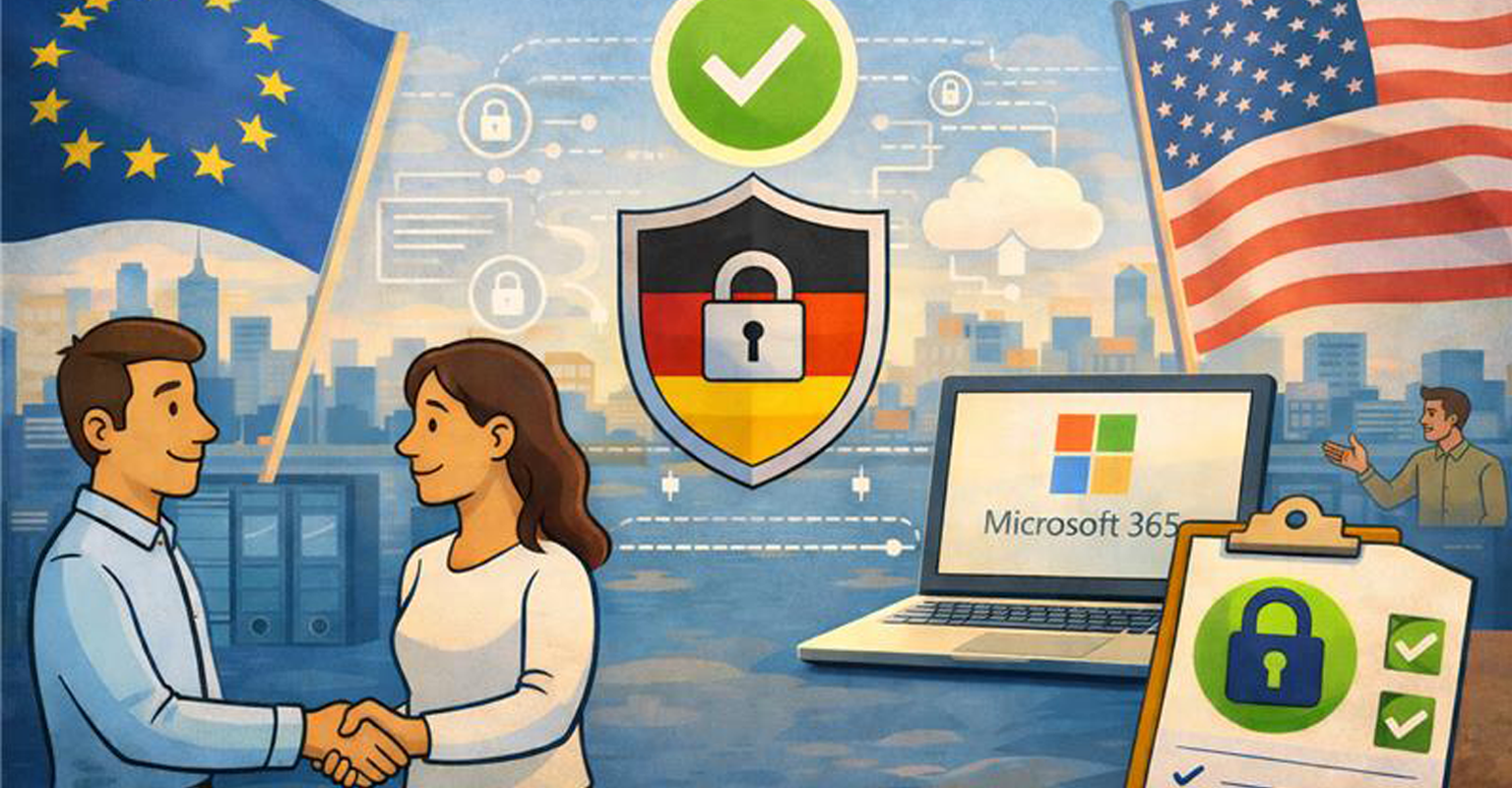
Data sovereignty in day-to-day business
How the Online Compliance Center safeguards the use of international software
Companies in Germany and Europe today face a clear reality: powerful cloud software such as Microsoft 365 is an integral part of everyday working life. At the same time, the requirements for data protection, auditability and legally compliant data processing are increasing. Data sovereignty is thus becoming an operational task that must be taken into account in day-to-day operations.
The Online Compliance Centre was designed precisely for this scenario.
Why data sovereignty is more than just a platform issue.
Current legal disputes in the US show that software manufacturers are repeatedly faced with accusations of processing data on a larger scale than users expect or than is legally permissible. Issues raised include:
- automated analysis of communication data
- data collection despite deactivated settings
- sharing of information with third parties
These cases make it clear:
Data protection risks often arise not from technical security vulnerabilities, but from a lack of transparency, unclear processes, and limited control options.
A widely used platform in Germany: Microsoft 365
A central platform with heightened compliance requirements
Microsoft 365 consolidates emails, chats, files, and calendar data in a central location, making it one of the most widely used platforms in German companies. This results in increased requirements regarding:
- Access control
- Retention and deletion policies
- Documentation of processing purposes
- Fulfilment of information and evidence obligations
Microsoft provides numerous technical functions for this purpose. However, whether these are used in a GDPR-compliant manner depends largely on organisational implementation and the accompanying processes within the company.
In addition to using suitable tools, it is therefore advisable to establish clear processes that support efficient storage management and controlled data retention.
The role of the Online Compliance Center
The Online Compliance Center is designed as a security-related addition to Microsoft 365. It enables the legally compliant use of the platform – particularly through the integrated archiving module – whilst also helping to ensure the availability and control of business-critical data.
In addition to fulfilling statutory archiving and retention obligations, the Online Compliance Center ensures that relevant or even business-critical data does not remain exclusively within the Microsoft environment. This means that, in an emergency or as part of an exit strategy, the data remains available to the company – regardless of Microsoft’s operational availability.
The Online Compliance Center does not interfere with content or search through data. Rather, it creates the organisational, technical and documentary conditions for the controlled, transparent and traceable use of Microsoft 365.
Specifically, the Online Compliance Center supports companies in:
- Implementing archiving and retention obligations in a legally compliant manner,
- keeping data available in a structured and traceable manner outside the operational platform,
- meeting data protection and compliance requirements for Microsoft 365 with suitable modules,
- and Providing audit-proof evidence.
In this way, companies retain control over their data – even when technical, contractual, or strategic conditions change.
Data sovereignty as a conscious business decision
Data sovereignty is not limited solely to structure and transparency. Companies must consciously address the question of how accessible their data is at all times, how data protection requirements are implemented, and what dependencies arise from the use of international software solutions.
Particularly when using US software, it is not enough simply to organise existing systems. Companies are required to weigh up whether and under what conditions the use of a platform makes sense – for example, through additional safeguards – or whether its use is at all justifiable under the given circumstances.
The Online Compliance Center supports companies in this assessment by enabling the use of Microsoft 365 whilst simultaneously ensuring, through supplementary security and archiving mechanisms, that data remains available, controllable and compliant with data protection regulations – even in exceptional situations or in the event of strategic changes.
For companies operating within the European legal framework, this is crucial: responsibility for data protection and data availability always remains with the company itself.
Conclusion
For many businesses today, the use of US software solutions such as Microsoft 365 is unavoidable. What matters, therefore, is not merely the platform’s origin, but how data is secured, kept available and maintained under the organisation’s own control in the long term.
The Online Compliance Center sees itself primarily as a security supplement to Microsoft 365. It not only creates the conditions for legally compliant use, but also ensures that business-critical data always remains accessible – even independently of Microsoft, for example in an emergency or as part of an exit strategy.
Furthermore, the Online Compliance Center helps companies manage their data efficiently, for example by offloading and optimising SharePoint storage without disrupting day-to-day operations. This delivers not only compliance benefits but also technical and economic advantages.
Data sovereignty therefore does not mean doing without international software, but rather consciously supplementing it with additional safeguards. The Online Compliance Center helps companies retain precisely this control over their data – transparently, traceably and permanently.